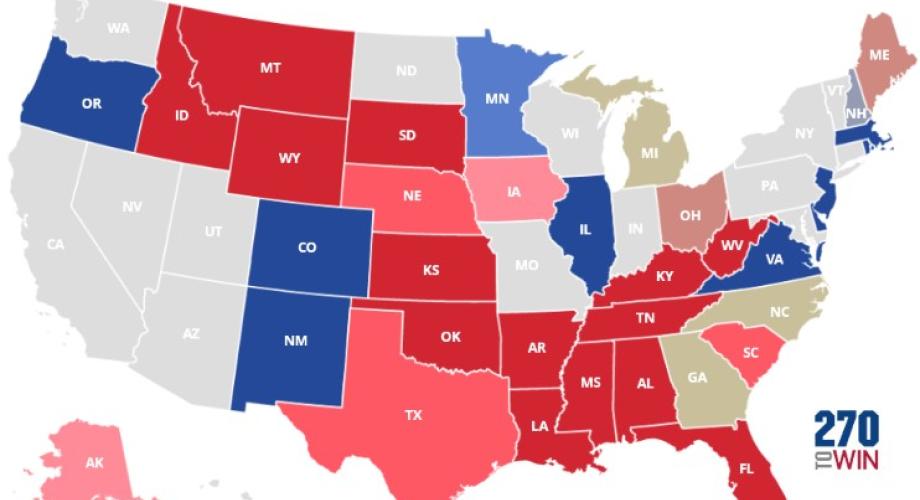
Last edition, we noted that generic ballot averages typically begin to tighten post-Labor Day as Republicans start to “come home.” That hasn’t happened this cycle, which in past years would already be flashing warning signs of a potential wave election. Democrats entered September with a D+6.7 lead on Silver Bulletin's generic congressional ballot and are now up to D+8.1 - their high point this cycle. Nate Silver's adjusted version for likely voters is wider still, at D+9.2. President Trump’s standing keeps sliding downward - Trump's net approval hit a new low of –22.4 as of September 28. At this point in his first term he was at –11.6. Unsurprisingly, you’re starting to see Republican lawmakers publicly break with the president on issues like ICE, tariffs, the handling of the Iran war, gas prices and trade.
What the Political Forecasters are Saying
Nate Silver's forecast model now favors Democrats in both chambers. The three versions of his model give Democrats between a 63% and 69% chance of winning the Senate and Silver has argued the battle for Senate control should no longer be called a toss-up. When his model launched in August, it gave Democrats an 87% chance of winning the House; the environment has moved further their way since.
Nathan Gonzales at Inside Elections is more measured. He presently projects Democrats gaining between 2 to 10 House seats, against the 3 they need for a majority. In the Senate, Gonzales projects Democratic gains of two to four seats. The top of that range is exactly the net four seats that Democrats need to take control the Senate.
A word of caution: polling error is always possible and it wouldn't take much of it to cost Democrats the Senate. A 50-50 Senate would still leave Republicans in effective control, with Vice President JD Vance tie votes.
The Senate Battleground Map is Getting Bigger
A year ago, Democrats needed nearly everything to go right to be competitive and in position to possibly net the four seats required for a majority. Now they are competing in states they haven't seriously contested in decades. In the past week, Inside Elections shifted two GOP strongholds toward Democrats: Kansas moved from Likely to Lean Republican and South Carolina from Solid to Likely Republican.
The Core Battleground States
North Carolina is Democrats' best pickup opportunity - an open seat where former Gov. Roy Cooper faces Republican Michael Whatley. Silver Bulletin shows Democratic candidates with at least slight polling leads in the six likeliest tipping-point states: Texas (D+3.4), Maine (D+2.5), Ohio (D+4.5), Iowa (D+2.0), Michigan (D+3.2) and Alaska (D+2.4).
In Texas, Democratic State House member James Talarico faces Attorney General Ken Paxton after defeating Sen. John Cornyn (R-Texas) in the primary. In Alaska, former Rep. Mary Peltola is challenging Sen. Dan Sullivan (R-Alaska). In Maine, Inside Elections moved the race from Tilt Republican to Toss-up. While Democrat Senate candidate Troy Jackson leads most polling, it’s distinctly possible that Sen. Collins (R-Maine) will outperform the polls again, as she has previously. NAAPAC supports Sen. Collins, who chairs Appropriations and has backed many of our housing priorities.
The Reach States
Kansas is the clearest sign of expansion benefiting Democrats. Democrats are hitting Sen. Roger Marshall (R-Kan.) over reported debt-collection lawsuits from his former medical practice and he faces a strong opponent in Methodist pastor Adam Hamilton. Hamilton has the endorsement of former Republican Gov. Bill Graves. The most recent Republican poll shows Marshall ahead by just 49-44. Democrats haven't won a Kansas Senate race since 1932; the fact that this state is even competitive says a lot about the environment.
South Carolina is also on the list. Sen. Darline Graham (R-S.C.) faces Democrat challenger Annie Andrews in a race Inside Elections has shifted from Safe to Likely Republican. Graham was appointed in July to fill the seat of her late brother, Sen. Lindsey Graham and later won the Republican nomination for the full term.
Republicans Are Playing Offense Too
Some pundits have recently noted that both New Hampshire and Minnesota – two open seats previously held by retiring Democrats - are seeing Republicans make aggressive plays for these seats. According to Inside Elections, New Hampshire has moved into Toss-up territory, while Minnesota is now seen as Likely Democratic. Democrats must hold both, along with Michigan and Georgia. If they lose any seat they currently hold, they need a fifth pickup to offset it.
Ohio: Sherrod Brown and the Banking Gavel
Of all this fall's Senate races, Ohio may matter most to rental housing. Former Sen. Sherrod Brown chaired the Senate Banking Committee in the 117th and 118th Congresses before losing in 2024 to then-candidate Bernie Moreno. He is now challenging Sen. Jon Husted (R-Ohio) in November’s special election. If Brown wins, expect him to make a play for his old gavel. Based on precedent and past accommodation, Brown would technically keep his seniority on Banking, which could let him edge out Sen. Elizabeth Warren (D-Mass.), the committee's current Ranking Member. Brown has said Senate Democratic Leader Chuck Schumer (D-N.Y.) made "no promises" on his seniority or the chairmanship. The practical point for our industry is this: next year's Democratic leadership on Banking may come down to Sen. Warren or Sherrod Brown. Both would set a very different housing agenda from the one Chairman Tim Scott (R-S.C.) has run.
Battle for the House
Democrats need a net gain of just three seats, and rating changes continue to keep moving their way. On September 22, Inside Elections shifted a dozen more races toward Democrats. That included Florida's 14th, which Republicans redrew to defeat Rep. Kathy Castor (D-Fl.) and which now moved from Tilt Republican to Toss-up. The battleground is also reaching into new territory. Florida's 16th and Texas's 9th both moved from Solid to Likely Republican and so did Wisconsin's 1st, held by Rep. Bryan Steil (R-Wisc.). Republicans in some cases are having trouble in open seats, where they have no well-known incumbent with a built-in base of support. Inside Elections editions have noted that without mid-decade redistricting, their pickup projection for Democrats in the House would likely be 5 to 15 seats, or potentially as high as 10 to 20 – a feat unto itself given the shrinking number of competitive House districts.
Missouri: Cleaver's District Restored
One of those redistricting fights just ended in an industry ally’s favor. In 2025, Missouri Republicans passed a map that split up the Kansas City–based 5th District to unseat Rep. Emanuel Cleaver (D-Mo.) and give the GOP functional control of seven of eight seats. Opponents gathered more than 300,000 signatures to force a referendum. On September 3, the Missouri Supreme Court unanimously ruled that the referendum belongs on the November ballot and that the new map can't be used until voters approve it. The U.S. Supreme Court later reinforced this outcome (including on September 25), warning that switching districts this late would cause electoral chaos, as general election ballots with the 2022 lines were already mailed out. Missouri will use its 2022 map lines, even though the August primaries ran under the new map.
Rep. Cleaver now faces state Sen. Rick Brattin in a heavily Democratic seat he won by nearly 24 points in 2024. NAAPAC has long supported Rep. Cleaver as a pragmatic ally who works with our industry. The fight isn't fully over: voters will decide the new map's fate in November and that vote will determine the lines for 2028.
What Chamber Flips Would Mean for Rental Housing
If Democrats take the House: The committee gavels change hands and Financial Services matters most to us. Rep. Maxine Waters has said she still intends to chair the committee if Democrats win. Expect the agenda to shift from supply and deregulation toward oversight. That likely means hearings on institutional ownership, rent-setting practices, fees and tenant protections, plus close scrutiny of Treasury's ROAD rulemaking. Progressive bills from the likes of Rep. Ro Khanna (D-Calif.) involving hedge fund tax penalties could get hearings, and the path for Respect State Housing Laws Act could prove even more difficult.
If Democrats take the Senate: The Banking gavel would go to Sen. Warren unless Sen. Brown wins in Ohio and moves to reclaim it. Warren has made corporate landlords and algorithmic rent pricing signature issues and Brown's chairmanship also leaned heavily toward consumer and tenant protections. Either way, expect Banking to focus on oversight rather than supply. A Democratic Senate would also control confirmations for the HUD, FHFA and Treasury officials who carry out the ROAD to Housing Act.
If they take both: Unified Democratic control still runs into a Republican president's veto and the 60-vote filibuster, so sweeping housing legislation is unlikely to become law. The fight moves to oversight, subpoenas and must-pass spending bills, where policy riders get attached. That makes committee relationships more important, not less.
Under any outcome, rental housing policy will be written by whoever sits on Financial Services, Banking, Ways and Means, Finance and Appropriations. NAAPAC's bipartisan approach is robust and built for any contingency. Industry allies like Rep. Vicente Gonzalez, the lead Democratic cosponsor of Respect and a member of Financial Services, and a whole host of partners like Rep. Cleaver in both chambers are why our issues stay bipartisan no matter who holds the gavel.
If you haven't made your 2026 NAAPAC contribution, now is the time. Election Day is five weeks away.