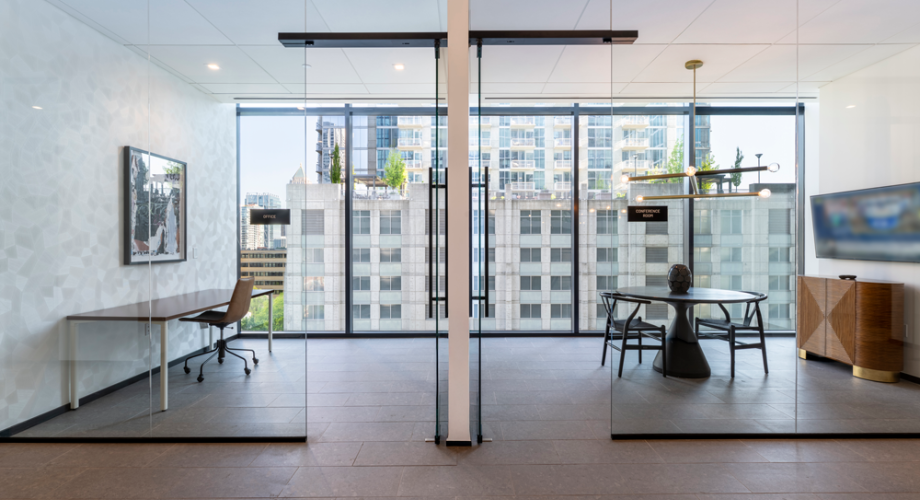
More than a third of residents make their apartment or community space a home office.
Two-bedroom apartments being used to house residents are going out of style.
It’s not because of square footage, but rather how that space is being earmarked.
More than one-third of apartment residents in professionally managed communities work from home at least a few days a week, often in what could be considered a two-bedroom apartment, where the second bedroom is frequently designed and better utilized as a home office.
This percentage has stabilized lately, coming off a period during and immediately after the pandemic when companies and their employees were in a wait-and-see period about returning to the office, followed by the acceptance of remote working.
Apartment operators quickly adapted to meet the needs of these residents due to COVID-19, and they continue to modify and highlight how working from home can be accommodated within the apartment home or in the community’s common areas.
Some communities, such as Joule House, a new development in the Wynwood area of Miami, developed by Fisher Brothers, recognized the growing demand for work-from-home space and chose to stage a one-bedroom model as a dedicated office.
The result has been a powerful draw for prospective renters, resonating strongly on tours. Many visitors are less interested in having a traditional second bedroom and more inspired by the flexibility of an at-home workspace.
It’s a deliberate design decision that underscores how Joule House is rethinking residential living for the hybrid, work-from-home era.
A Nationwide Trend
Beth Argaman Tabarly, Bozzuto’s Regional Associate and lead at Joule House, said that approximately 42% of its residents currently work from home, and this number continues to trend upward.
“We’ve seen a steady increase over the past year, reflecting how strongly hybrid and remote lifestyles have taken hold in Miami,” she said.
The same can be said for many markets.
WithMe surveyed apartment residents from February to March 2025 and found that 35% of 3,580 respondents work from home five to seven days a week. Another 35% work from home one to four days a week. In total, 70% of respondents work from home at least one day per week.
Nearly a third of residents (28%) use their building’s community space — either exclusively or in combination with their apartment — when working from home, and 22% of residents alternate between their apartment and the community space when working remotely. More than 600 residents reported splitting their time between their apartments and shared spaces.
Three-fourths said having access to co-working space impacts their decision to continue living in their current apartment building.
Additionally, in a WithMe survey of over 4,500 residents, nearly 40% reported that working from home had a significant influence on their apartment choice.
In a survey of 4,534 residents, more than half reported that remote work was a factor in their decision to choose an apartment.
Hybrid workers reflect the best opportunity to drive premium environments, according to RCKRBX.
It finds that, among the data relating to contribution to rent levels by time in office, one-third of the highest rent payers are hybrid, working one to two days from home, and that one-quarter of the highest rent payers work from home three to four days or are fully remote.
This population is significantly more responsive to optimized/ideal amenity and interior programs, according to the firm.
Co-Working Options ‘Not an Afterthought’
In addition to its office within the two-bedroom layout, Joule House features three individual private offices, a conference room and a large co-working lab with communal seating.
The co-working lab is equipped with a printer, a complimentary coffee bar and high-speed internet.
“The co-working lounge was not treated as an afterthought but curated with the same attention to design as the pool or fitness center,” Argaman Tabarly said.
“What was once just another box to check in multifamily projects is now, some argue, the most important amenity,” she said. “The lounge is an inviting space featuring private pods for quiet focus, a conference room for meetings and communal areas such as mini-lounges and a large, shared table.
“Even the game room placement was purposefully located right next door so residents can recharge with a quick arcade session before diving back into work.”
PMG, through its multifamily lifestyle communities, Society Living, intends to “redefine” the apartment experience in urban cores across the country in places such as Nashville, Tenn., Brooklyn, N.Y., and Fort Lauderdale, Fla.
“Remote work is becoming central to people’s lives,” said Ryan Shear, Managing Partner with PMG. “Our communities are intentionally designed to meet their evolving needs.”
Along with the customary co-working spaces that feature private offices, open lounges, meeting rooms with screens and even podcast studios for resident creatives are being constructed. It provides crucial mesh Wi-Fi throughout the building, along with practical touches such as printing stations, soundproofed areas and onsite mini markets for convenient snacks. Every detail is thoughtfully curated to support productivity and bring comfort.
It also hosts regular networking events and stages units with dedicated home office setups to reflect how its residents truly live and work.
Working from home also means easier lunch breaks.
Jennifer Antos, BH, Senior Vice President – BTR, said BH strives to bring convenience to its multifamily residents working from their apartment homes.
“People want to be close to shops to run quick errands and fast-casual food options for WFH lunch on the go,” Antos said. “It’s not just about what’s in the homes or the community, but what’s nearby that makes the WFH experience better.”
Get Dressed and Go Downstairs
CRG has delivered or has under construction approximately 40,000 apartment homes, primarily as conventional multifamily housing, and 3,500 student housing beds.
Alison Mills, Vice President of Design & Development, said that work-from-home arrangements have tapered off somewhat in recent years and have stabilized for now, with about one-third of the company’s conventional residents working from home in some capacity. Students, she joked, naturally “work from home.”
Its one- and two-bedroom apartments include a few nooks that enable desk set-ups.
“People look for work-from-home resources throughout the building,” she said.
The firm offers various options, including “Zoom rooms,” co-working lounges and individual spaces. “They are being used all of the time,” Mills said. “There’s very high demand. These spaces aren’t just soft seating with the television monitor.”
For students, there are silent spaces and social spaces that can accommodate four to six students, where they can connect to a TV and work on projects together.
Demand for live-work-play spaces is heightened, according to Marilyn Russell, Principal and Director at Baker Barrios Architects, who specializes in multifamily housing, including projects for Greystar in select Florida markets.
“Residents want to work in these spaces because they want to escape their living space,” Russell said. “They want to get dressed up and go downstairs. They might rent an office downstairs for a few hours to get some work done. They want to be able to feel that their workday is over and they can return to their apartment.”
Taconic Partners owns and manages a portfolio of rental residential buildings across New York City and has seen increased interest in workspaces in amenity areas, rather than in apartment units themselves.
Andrew Schwartz, Senior Vice President, Residential Asset Management, Taconic Partners, said that with more residents working from home full-time and engaging in hybrid schedules, there is increased demand for reservable private conference areas, private phone rooms and open work areas where residents can still socialize and be around their neighbors, particularly if the building offers other desirable amenities.
Taconic leased up The Ellery, its most recently completed rental project, in just 10 months, in large part due to the amenity package, which includes workspaces that were a huge draw, he said.
“[Our residents] want a place to set up a laptop and work outside the home, but with the convenience of being inside the property,” Schwartz said.
Katie Kerkhoff, Senior Regional Property Manager, Greystar, said, “You can’t open a new community now without thoughtful work-from-home common area space. A recent trend I’ve noticed is sacrificing space in individual units to create more communal work-from-home spaces in the common-area amenities, while encouraging and prioritizing a sense of community.
“This approach is definitely more concentrated in the city where space is a luxury, though, and suburban assets almost always include a built-in desk in their larger floor plans—a trend I thought I’d see fall by the wayside,” Kerkhoff said. “ We also always try to consider the needs of a work-from-home-based lifestyle by prioritizing high-end, stocked coffee stations and fresh water with fruit in those common areas.”
Nichole Oswald, Regional Property Manager at Hines, noted that a strong amenity package, which promotes a resident’s lifestyle (including work-from-home options), has led to higher retention rates.
“Work-from-home space is no longer a nice-to-have, but rather a need-to-have to stay relevant in the market,” Oswald said.
Gaetano Caltagirone, President of The Calta Group, had the foresight to redesign the amenity plan for a property acquired around the time of the pandemic, creating flexible spaces where residents could work openly, privately or collaboratively without needing to leave the building.
“Anticipating that some aspects of remote work would remain, we went further by designing live-work apartments – two-story residences with living areas upstairs and office/retail-style spaces downstairs,” Caltagirone said. “This unique configuration provides the best of both worlds: A true home environment combined with a professional setting and strong street-facing presence.”
Chicago-based Fifield has prioritized work-from-home space in its design for several years. At its recently launched Miami project, Amara Wynwood, 35% to 40% of residents work from home at least part of the week, according to Ken Lodge, its Vice President of Asset Management.
For those who prefer to work from home, space is available for a desk in the living area, and the kitchen island also has plug-in opportunities for their computers.
“We’re very thoughtful about our closets,” Lodge said. “We want them to be high-quality and configured to include hanging racks, cabinets and drawer space. That way, no dresser is needed, and it leaves room for a desk.
“At this stage, providing a work-from-home space is expected,” he said. “It’s not considered a luxury amenity.”
Paul Bergeron is a freelance writer.
Photo credit: Society Atlanta developed by PMG