What excites experts most about the current year in design trends, community planning and adjustments in operations.
Lobbies as loungey gathering hubs, workspaces with private podcast and conference call rooms, fitness trails with activity stations and leases shorter than 12 months.
Industry sources welcome trends to generate buzz, attract residents, make living more pleasurable and set properties apart. “It’s still a matter of one-upmanship,” says Brad Lutz, AIA, Managing Principal with architects Baker Barrios. But with longer construction timetables and soaring costs, developers hope their trends have staying power.
Timeless Design
Rachely Rotem, Associate Principal, Architect, AIA, FAAR, LEED AP at CetraRuddy, says her firm avoids trends in favor of designs that may become classics. For inspiration, firm members look at the history and aesthetics of the building or neighborhood, then add what she calls crafted beauty. “Through thoughtful design and collaboration, we create enduring spaces that reflect legacy, cultural richness and a commitment to longevity,” she says. At Claremont Hall, a project combining historic adaptive reuse and new construction on the Union Theological Seminary campus in New York City, the former student refectory became an indoor swimming pool with original Gothic ceiling, chandeliers, beams, trusses, leaded glass windows, stonework and fireplace refurbished to honor the building’s history.
Quiet Wellness
Wellness’ latest iteration reveals efforts to incorporate it in quieter ways. M&R Development is building its first meditation room and Zen Garden at The Bluffs on Lake, a 278-room luxury property on a bluff overlooking Lake Michigan in St. Francis, Wis., which RMK Management will lease and manage when complete. “Residents want intentional spaces to reflect, focus and reduce stress,” says Diana Pittro, Executive Vice President, RMK Management. Similar outdoor features include herb and vegetable garden planters, hammocks and an infinity-edge pool with sun shelves.
The Architectural Team (TAT) has tapped into the trend with amenities that add a homey touch like pizza ovens and games. Baker Barrios is adding a shared pantry indoors stocked with healthy foods to purchase at a luxury property in Aventura, Fla., for Ram Realty Partners & Pinnacle, along with a Kosher kitchen. Jeff Klotz, CEO, The Klotz Group of Companies, likes the idea of offering hydrogen and fruit-infused water to help residents stay hydrated. At some communities, being healthy means greater activity, so KTGY designs gear rooms for sports equipment to share, along with e-bicycle charging stations, cold plunge pools and saunas, says Kyle Millar, AIA, NCARB, Principal, Denver studio. Staying fit and well contribute to healthier bodies and stronger communities, says Mary Cook, President and founder of Mary Cook Associates.
Community Togetherness
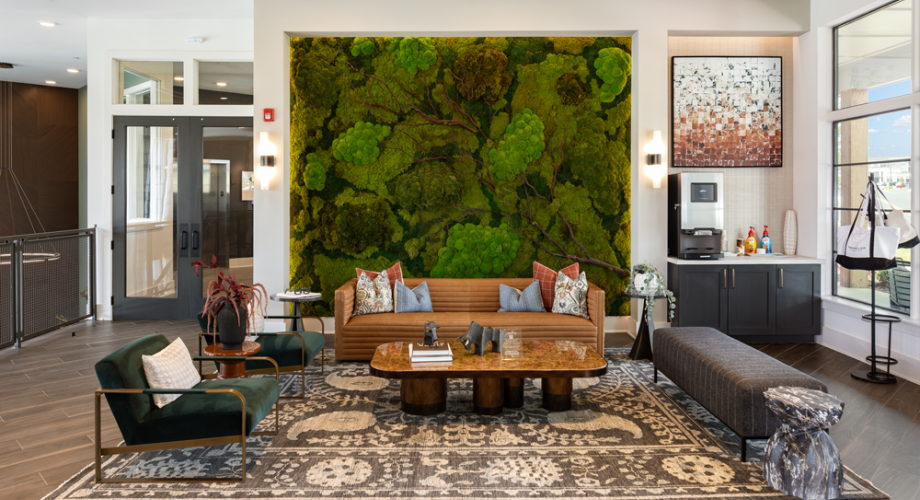
More spaces are designed through choice of furnishings and placement, equipment, programming, services and staff so residents connect to socialize, improve mental health or reduce digital fatigue, Cook says. As a result, lobbies are designed as living rooms, says Meghann Van Dorn, Director of Interior Design and Associate at TAT. Klotz says the trend reflects a growing “café culture,” with variations by demographic. “Younger cohorts favor modular furniture, mood lighting and ambient soundscapes while older residents want acoustic zones, ergonomic seating and concierge-level service,” he says. Shared interests foster belonging. Optima properties offer indoor pickleball and golf simulator leagues, book clubs, Mahjong and Canasta groups and knitting clubs. Outdoor areas gain edible gardens, co-working stations and shaded cabanas, says Al Lord, Owner, Lexerd Capital Management. Baker Barrios sees more clients tap staff and outside vendors to lead classes. Food remains a people magnet. Lexerd Capital Management renovates communal kitchens. Marquette Management brings food trucks in and partners with local restaurants, wine bars and coffee shops to bring a feeling of community to their properties. Many developers also increase pet-friendly spaces and events. And even a temperature-controlled waiting area with seating for ridesharing becomes a place to converse, says Millar. The jury remains mixed whether to increase or decrease room sizes, with Marquette Management making them bigger post-pandemic to host larger events and for residents with similar hobby-interests, according to Cheron Eich, Director of Operations, and KTGY making them smaller for intimacy, says Millar. To encourage belonging, Marquette has a program called “Community Life Architects,” which includes individuals who reside onsite and provide time each week dedicated to helping residents feel part of their community.
Diversification
As needs vary, developers step up with options. At its 25 Water Street property in New York City, the biggest conversion it’s worked on with 1,320 apartments, CetraRuddy designed 70 different layouts—some with extensions of a living room for a home office or yoga retreat that can easily change over time, says Rotem. Unit sizes vary by family needs and budgets, which adds to more interesting social interactions, she says. After decreasing unit sizes, Brook Farm Group is considering the addition of 50 to 100 square feet to apartments, sometimes with a den, says Peter DiCorpo, Chief Operating Officer. His company develops different products to meet various budgets.
Infill Agrihoods
“Patch” by KTGY is a concept that adds a variation on an agrihood where residents have access to produce in a farm setting but in a smaller infill build-to-rent (BTR) neighborhood. Smaller sites lead to smaller, more affordable homes that still prioritize outdoor community space and downplay parking, says Marissa Kasdan, Director of Research and Development. “It’s one way to help make a smaller home feel large,” she says. In some recent examples, the outdoor space doesn’t feature a garden, but a playground, pool, grilling station, she says, and a separate area apart from homes is set aside for parking to deemphasize internal streets and encourage walking. Veranda Dellbrook, its 182-unit BTR community developed with Empire Communities outside Houston, uses a repeatable 634-square-foot core plan to streamline construction.
Browns Plus Texture
Cooler whites and grays are giving way to the return of browns in furniture, flooring, wall paneling, cabinets and wallcoverings, says Van Dorn. She also sees more browns and greens in trim rather than white. “People want traditional design that was popular before technology surged,” she says, adding, “The world is more chaotic, so people are eager for cozy and warm.” A newer twist on what’s old is that texture again is in such as matte metallics and layered textures, Klotz says. Lord sees tactile touches in ribbed wall panels and organic linen wallpapers. “The goal is comfort that feels intentional,” he says.
Tech 2.0. Everyone is Looking to AI for Help.
Specifically, the search continues for ways residents can program more services and programs on their phones to simplify life, from turning on air conditioning before they arrive home, having thermostats learn their routines, sensors that detect water leaks, track energy use or request maintenance, Lord says. Management also wants tech to help it operate more efficiently whether servicing maintenance requests, renewing leases, answering inquiries or capturing leads, Cook says. Garages are being spiffed up technologically for safety, climate control, speed of delivery and cost, Klotz says.
Affordable Housing
TAT incorporates favorite market-rate features such as balconies and pantries in units and fire pits in outdoor shared spaces, and scales back in other ways such as staying away from expensive finishes. More developers do so by partnering with local government organizations and nonprofits to get buildings constructed and offer programs and services that help residents and revitalize neighborhoods. An example is Fairstead’s partnership with Alexandria Redevelopment and Housing Authority and The Communities Group to redevelop the 66-unit Samuel Madden Homes in Old Town, Alexandria, Va., into a $120 million, mixed-use development with 207 affordable apartments, amenities such as a podcast recording room, community room, business center, free Wi-Fi and a 500-square-foot food hub. The building is being constructed with quality sustainable materials and will be completed in fall 2027, says Lauren Jolliver, Senior Associate of Development at Fairstead.
Conversions to BTRs
Because BTR homes continue to attract residents, more developers are looking to BTR to address affordability and flexibility challenges, says Jason Joseph, CEO and Managing Partner, Trilogy Investment Company. Conversions can meet demand without compromising design and finishes and provide residents with more space than they might find in comparable apartments. Converted homes often feature higher-end materials, energy-efficient systems and community amenities originally intended for ownership, giving renters a premium-living experience without long-term financial commitment, he says. Renters gain larger floor plans, private outdoor spaces and access to shared facilities. The company completed one conversion at REV3 at Millcreek in Athens, Ga., and expects to close on two others this year.
Academized Student Housing
More families are pushing back on luxury student apartments on campus and for purpose-built student housing (PBSH). “There’s still demand for bed-bath parity, in-unit laundry and ground-level spaces to gather or grab coffee,” says Nina Farrell, Executive Director of Government and Education Advisory Practice at JLL. “Students want maker spaces and rooms for experiential learning and living labs.” But luxury amenities like lazy-river pools are out; in favor is a growing emphasis on “academization”: Places to study, relax, cook, play games, be outdoors, practice spirituality and access technology. JLL is seeing more modular building systems that construct faster, enable easy renovations and changes and deliver sustainability through building system efficiencies. “Properties can be marketed for long-term, lower operational costs,” Farrell says.